
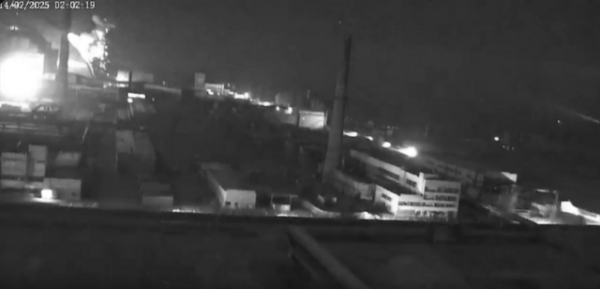

Nearly four decades after the explosion at Chernobyl marked the world’s worst nuclear disaster, Ukrainian officials are warning that the site’s fragile safety balance is again under strain—this time from war.
Authorities say a drone strike in February punched a large hole in the New Safe Confinement, the massive steel dome designed to seal in radioactive material from the ruined reactor for at least 100 years. Ukraine has blamed Russian forces for the attack, which compromised the outer shield that sits atop the original Soviet-era sarcophagus hastily erected after the 1986 catastrophe.
Nearly a year later, repairs are underway inside the cavernous structure. Scaffolding stretches toward the arch’s ceiling, a temporary patch covers the main breach, and workers continue sealing hundreds of smaller holes left during emergency firefighting efforts. Burned debris from the strike remains scattered on the floor, a visible reminder of how close the site came to a far more serious failure.
“It does not perform the function of retaining radioactive substances inside,” plant director Sergiy Tarakanov explained to AFP, echoing assessments by the International Atomic Energy Agency that the shield has lost key elements of its protective role. The damage has also cast doubt on whether the structure can meet its intended century-long lifespan.
The episode has revived memories of the early days of the war, when Russian troops briefly occupied the Chernobyl site after launching their full-scale invasion of Ukraine in 2022. Ukrainian officials have since accused Russia of repeatedly endangering nuclear facilities by striking energy infrastructure, occasionally cutting power to systems critical for monitoring and safety.
Despite those risks, Tarakanov said radiation levels have remained “stable and within normal limits,” including after an October power outage caused by a nearby attack. Engineers continue to monitor dozens of sensors around the clock.
Inside the wrecked reactor, the danger remains very real. Engineer Ivan Tykhonenko told AFP that remnants of the original 190 tonnes of uranium fuel “melted, sank down into the reactor unit, the sub-reactor room, and still exists,” underscoring why the integrity of the shelter is critical.
The greatest concern, officials say, is the prospect of another direct hit. “If a missile or drone hits it directly, or even falls somewhere nearby … it will cause a mini-earthquake in the area,” Tarakanov warned AFP. “No one can guarantee that the shelter facility will remain standing after that. That is the main threat,” he added.
Restoring the New Safe Confinement to full functionality could take another three to four years, Tarakanov estimates. Until then, the damaged dome stands as a stark reminder that Europe’s most infamous nuclear site remains exposed.
[Read More: Kash Moves The FBI]






One missile, shell hit can effect site for more years to come worse than 1986
And don’t think for a second that Mad Vlad wouldn’t try something like that. The Russian people really need to do something to end him !!!