
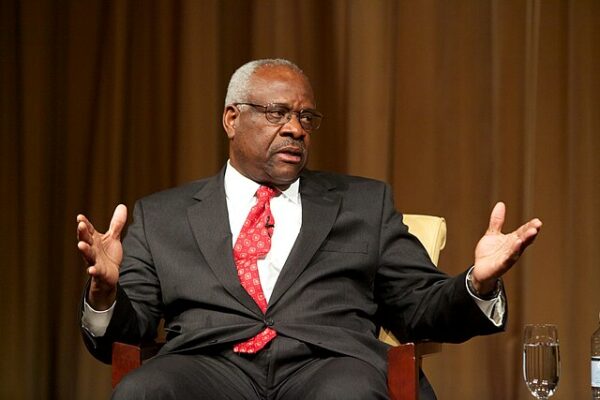

The Supreme Court on Friday struck down President Donald Trump’s sweeping tariff regime, ruling 6–3 that he exceeded his authority under the International Emergency Economic Powers Act (IEEPA). But in a pointed dissent, Justice Clarence Thomas warned that the majority had narrowed long-recognized executive power over foreign commerce and unsettled decades of trade practice.
The majority, authored by Chief Justice John Roberts, held that IEEPA — a 1977 statute designed to address foreign threats during national emergencies — does not authorize the president to impose tariffs. Roberts wrote that allowing such authority would grant the executive “the extraordinary power to unilaterally impose tariffs of unlimited amount, duration, and scope,” a step the Court said Congress had not clearly approved. The opinion relied in part on the Court’s “major questions” doctrine, requiring explicit congressional authorization for actions of vast economic and political significance.
The ruling invalidates central pillars of Trump’s trade agenda, including last year’s “Liberation Day” tariffs — a baseline 10 percent levy on imports from nearly every country, with higher rates targeting major trading partners such as China and members of the European Union. The measures, imposed under IEEPA, generated between $130 billion and $200 billion in revenue but triggered immediate legal challenges from importers who argued the duties amounted to an unlawful tax.
Thomas, dissenting, rejected the majority’s reading as historically cramped and legally unsound.
Justice Thomas cooks the majority with his dissent in today's tariff decision
"Congress authorized the President to 'regulate… importation.' Throughout American history, the authority to 'regulate importation' has been understood to include the authority to impose duties on… pic.twitter.com/QB5Cw7AZKa
— Breitbart News (@BreitbartNews) February 20, 2026
He argued that the statutory authority to “regulate … importation” has long been understood to include the power to impose duties. In Thomas’s view, tariffs are not some novel assertion of executive authority but a traditional instrument of foreign economic policy — one repeatedly employed in times of national emergency.
To underscore the point, Thomas pointed to President Richard Nixon’s 1971 decision to impose a 10 percent import surcharge under the Trading with the Enemy Act, a statute containing similar emergency language. That action, Thomas noted, survived judicial scrutiny. For decades, courts and political branches alike have treated emergency trade powers as encompassing tariff authority.
By contrast, Thomas suggested, the majority’s reliance on the absence of the word “tariff” in IEEPA elevates textual silence over functional history. Congress, he implied, legislated against a backdrop of established executive practice — one in which regulating imports included adjusting duties when national interests demanded it.
Justice Brett Kavanaugh, joined by Thomas and Justice Samuel Alito, authored a broader dissent warning that tariffs are a “traditional and common tool to regulate importation,” akin to quotas or embargoes. Stripping that tool from the executive, the dissenters argued, risks hamstringing American diplomacy and economic leverage during crises.
The majority dismissed those concerns, emphasizing that no prior president had invoked IEEPA itself to impose across-the-board tariffs of this magnitude. If Congress wishes to confer such sweeping authority, Roberts wrote, it must do so explicitly.
President Trump denounced the decision from the White House, calling it “deeply disappointing” and criticizing members of the Court — including some of his own appointees — for siding with the majority. He pledged to pursue “other alternatives” and “stronger” statutory authorities to restore or replace the tariffs.
Markets initially rallied on news of the decision, reflecting relief at the removal of broad import levies. Yet the legal and fiscal aftermath remains unsettled. The consolidated case, Learning Resources, Inc. v. Trump, now returns to lower courts to address questions including potential refunds for duties already collected.
[Read More: Trump To Disclose What We Know About UFOs]






Thank U Thomas U Get it the Rest dontr
John Roberts once again shows he has been a disgrace to the SCOTUS since appointed by a BUSH president, known to not be conservative in any way.