
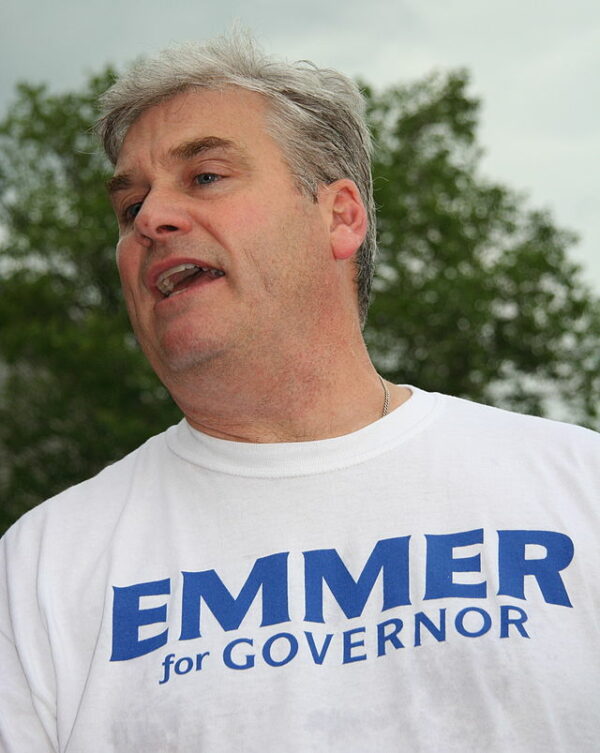

A ten-year-old town hall exchange in central Minnesota is again circulating online, reopening debates over immigration policy, local consent, and political accountability as national attention returns to refugee resettlement and assimilation.
This renewed interest is rooted in a decade-old exchange that continues to spark debate. The clip, originally aired by This American Life, captures a July 2015 town hall held at Aces Bar in St. Cloud, where residents confronted then–freshman Rep. Tom Emmer over the rapid resettlement of Somali refugees in the region. The exchange, largely forgotten outside local circles, has resurfaced amid renewed scrutiny of Minnesota’s immigration policies and the fallout from the Feeding Our Future scandal.
During the meeting, constituents voiced anger over what they described as a lack of local input in federal refugee decisions administered by Lutheran Social Services and Catholic Charities. One attendee bluntly challenged the process, saying, “We did not ask for those Somalis… Nobody asked us if we, in St. Cloud, want those Somalis.” The remark reflected broader frustrations over housing, employment competition, public services, and cultural change in the city.
It's a long listen but this is a recording from a 2015 townhall in St. Cloud Minnesota where Tom Emmer basically told the citizens of St. Cloud that they have to take as many Somalis as they say whether they like it or not because "America". He calls them the fastest assimilating… pic.twitter.com/siHHIpGQM7
— Paul (@WomanDefiner) December 28, 2025
In response to these concerns, Emmer framed opposition to refugee resettlement as incompatible with America, arguing that immigration authority rests with the federal government. He compared Somali refugees to earlier immigrant groups and defended their integration record, stating, “Somalis, according to the measurements that have been used over time, are some of the fastest-assimilating populations that we’ve had.” Emmer cast immigration not only as lawful but as consistent with American historical patterns.
That hasn’t sat well with people like Ann Coulter:
And you wonder why Trump got elected.
<<Minnesotans did fight this and they were told to "shut up and sit down" by the Mn GOP.>> https://t.co/lulO2dPGm5
— Ann Coulter (@AnnCoulter) December 29, 2025
Despite Emmer’s reassurances at the time, critics now argue that such assurances failed to account for long-term consequences. Those critics now point to the Feeding Our Future case—one of the largest pandemic-era fraud schemes in the country—as evidence that earlier warnings from local residents were dismissed. The fraud ring, which some say could be as high as $9 billion just from Minnesota, has been allegedly run by the Somali community in Minneapolis.
Beyond high-profile scandals, data on public assistance usage among Somali households further fuels the debate. According to some studies, 81% of Somali households receive welfare programs. Additionally, 73% receive Medicaid—compared to 18% of native-born American households—and 54% receive food stamps, versus just 7% of native-born households.
Weeks after the St. Cloud town hall, Emmer co-founded the Congressional Somalia Caucus alongside then–Rep. Keith Ellison, now Minnesota’s attorney general. The bipartisan caucus was intended to address issues affecting Somali-American communities, which expanded rapidly in Minnesota beginning in the 1990s. By 2024, more than 75,000 residents of Somali ancestry lived in the state, according to demographic estimates.
The political repercussions of these events continue to unfold. As the fraud ring has been revealed, Emmer has been quick to backtrack, blaming Tim Walz, not his own decisions, for the alleged crimes. Now serving as the third-highest-ranking Republican in the House, Emmer is preparing for a 2026 reelection campaign in Minnesota’s 6th Congressional District, an area encompassing St. Cloud and fast-changing outer Twin Cities suburbs. Some conservatives have begun demanding he step down from his leadership position.
[Read More: Chernobyl Damage Sparks Concerns About Radiation]








Explain Emmer OK explain ALL remedy
This shows exactly what is wrong with the republicans party. Most of them are not what they pretend to be. Paul Ryan, Liz Cheney, Mike Pence, Michael Brown etc etc all reached the upper levels of the republican party(and now Emmer) before their true political leanings were revealed.