
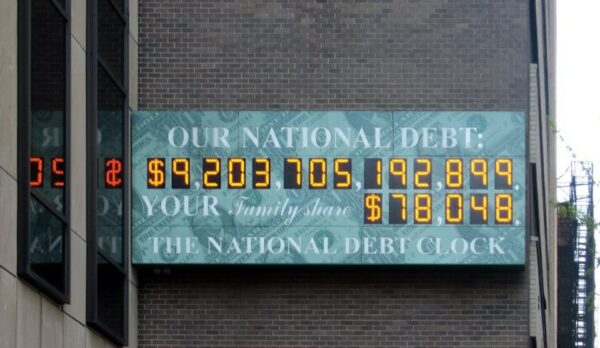

Fitch Ratings affirmed the United States’ credit rating at AA+ Thursday but warned that Washington’s failure to rein in spending and deficits is driving federal debt steadily higher and placing increasing pressure on the nation’s finances.
The ratings agency said U.S. government debt is already more than twice the median level among other countries carrying AA ratings. Fitch expects the debt-to-GDP ratio to rise from 117% at the end of 2025 to 123% by 2028 and potentially reach 128% by 2030 if current policies remain in place.
“The government has not taken meaningful actions to address the large general government fiscal deficits (averaging 7% of GDP since 2022), and spending pressures will mount over the next decade due to an aging population,” Fitch stated in its rating action commentary.
The problem is not expected to improve soon. Fitch projects federal deficits will reach 7.4% of GDP in both 2026 and 2027, continuing a stretch of unusually large deficits even outside a recession or national emergency.
The rising debt is also making the government increasingly expensive to finance. Fitch expects government interest costs to consume 12.6% of revenue by 2028, compared with a median of just 3.5% among other AA-rated countries.
BIDENOMICS:
"Fitch has downgraded the U.S. credit rating to AA+ from AAA," a ranking the U.S. had held at Fitch since 1994. pic.twitter.com/J7oPMi7Wip
— RNC Research (@RNCResearch) August 1, 2023
That growing interest burden means a larger share of federal revenue will be devoted simply to servicing past borrowing rather than paying for current programs, while leaving the government more exposed to higher interest rates and future economic downturns.
Fitch said the United States continues to benefit from enormous structural advantages that prevent the debt problem from immediately translating into a lower rating. Those include the size of the U.S. economy, high per-capita income and the dollar’s dominant position as the world’s reserve currency.
The dollar accounts for roughly 58% of global foreign-exchange reserves, giving the federal government financing flexibility unavailable to most other countries.
But Fitch made clear that those advantages do not erase the underlying fiscal trajectory.
The agency also noted that the statutory federal debt ceiling, currently $41.1 trillion, is expected to be reached around the middle of 2027. Treasury Department measures could delay an immediate default afterward, but Fitch said repeated political fights over the borrowing limit remain a risk to the country’s credit profile.
The United States lost Fitch’s top AAA rating in 2023 amid concerns about rising debt and deteriorating fiscal governance. Thursday’s decision leaves the country one rating level below AAA with a stable outlook.
Fitch said another downgrade could come if debt metrics deteriorate significantly further or if confidence in the dollar’s reserve-currency status weakens.
Returning to AAA would require the opposite: sustained changes to taxes or spending substantial enough to put the federal debt-to-GDP ratio on a clear downward path.
For now, Fitch’s assessment amounts to a warning that the United States’ economic strength is still enough to support a high credit rating, but Washington’s mounting debt and persistent deficits are increasingly testing that advantage.
[READ MORE: Trump’s Victory On Prescription Drugs Is Facing A Media Blackout]