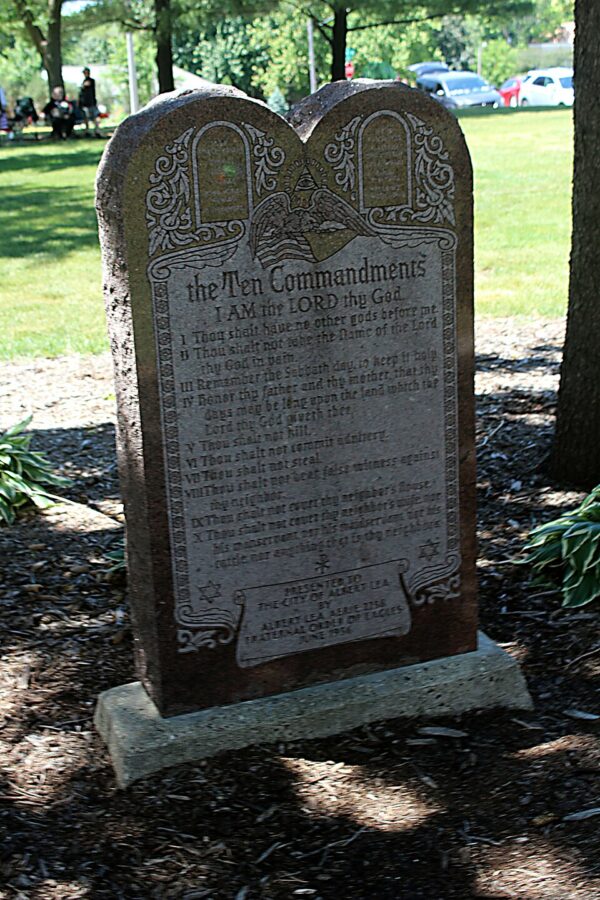

A coalition of Texas public-school families asked the Supreme Court on Monday to review a state law requiring the Ten Commandments to be displayed in every public-school classroom, arguing that a divided appeals court improperly disregarded longstanding precedent protecting religious liberty.
The families are challenging S.B. 10, a 2025 Texas law directing public elementary and secondary schools to place the Ten Commandments in a conspicuous location in every classroom using wording specified by the state and drawn from the King James Bible. Lawyers for the families asked the justices to overturn a ruling from the U.S. Court of Appeals for the 5th Circuit upholding the law, saying the appeals court “flouted this Court’s binding precedents and gutted the religious-freedom rights of public-school children and parents.”
The case could give the Supreme Court an opportunity to clarify how its recent shift in Establishment Clause doctrine applies to religious displays in public schools. In the 1980 case Stone v. Graham, the Court struck down a Kentucky law requiring public schools to display framed copies of the Ten Commandments, according to SCOTUSBlog.
The Court stated: “[i]f the posted copies of the Ten Commandments are to have any effect at all, it will be to induce the schoolchildren to read, meditate upon, perhaps to venerate and obey, the Commandments. However desirable this might be as a matter of private devotion, it is not a permissible state objective under the Establishment Clause.”
But the legal framework underlying that decision has since changed. Stone relied on the Lemon test, which required courts to consider whether government action had a secular purpose, advanced or inhibited religion, or created excessive government entanglement with religion. In its 2022 decision in Kennedy v. Bremerton School District, Justice Neil Gorsuch, writing for a six-justice majority, said the Lemon test had been “long ago abandoned.” Courts should instead look to history and the original understanding of the Constitution when considering Establishment Clause claims.
Texas enacted S.B. 10 three years later. Families from Christian, Jewish, Hindu and nonreligious backgrounds sued, arguing that the classroom mandate violates both the Establishment Clause and their free-exercise rights. The 5th Circuit, sitting en banc, upheld the law in April by a 9-8 vote, concluding that Stone could no longer control because its reasoning depended on the Lemon test.
“With Lemon extracted, there is nothing left of Stone,” the majority wrote. The appeals court said the relevant question was whether S.B. 10 “resemble[s] a founding-era religious establishment.” It concluded that it did not because the law does not carry out the “kinds of things ‘establishments of religion’ did at the Founding.”
It “does not tell churches or synagogues or mosques what to believe or how to worship or whom to employ as priests, rabbis, or imams. It punishes no one who rejects the Ten Commandments, no matter the reason,” the majority wrote.
The court also rejected the families’ reliance on the Supreme Court’s 2025 ruling in Mahmoud v. Taylor, which held that a Maryland school board violated parents’ free-exercise rights by refusing to allow opt-outs from instruction involving LGBTQ+ themes. The 5th Circuit distinguished the Texas law, writing that S.B. 10 “authorizes no religious instruction and gives teachers no license to contradict children’s religious beliefs (or their parents’).”
The families are now asking the Supreme Court to intervene, arguing that the appeals court effectively overruled Stone on its own. The 5th Circuit “believes that Stone was somehow overruled by Kennedy, even though Kennedy does not mention Stone. But only this Court can overrule its own decisions, and it does not do so silently,” the challengers wrote.
They also argued that the ruling conflicts with Mahmoud and weakens parents’ ability to direct their children’s religious upbringing. The decision, they said, would “contravene[e] this Court’s recent ruling in Mahmoud and destabilize[s] free-exercise law. If the permanent, unavoidable imposition of biblical scripture in public-school classrooms does not interfere with, or threaten to undermine, parents’ ability to direct their children’s religious education and to instill particular religious beliefs and practices, it is difficult to imagine what would.”
The Supreme Court has not yet indicated whether it will hear the case.
[READ MORE: Whitmer Praises Trump As Better Than Biden]