
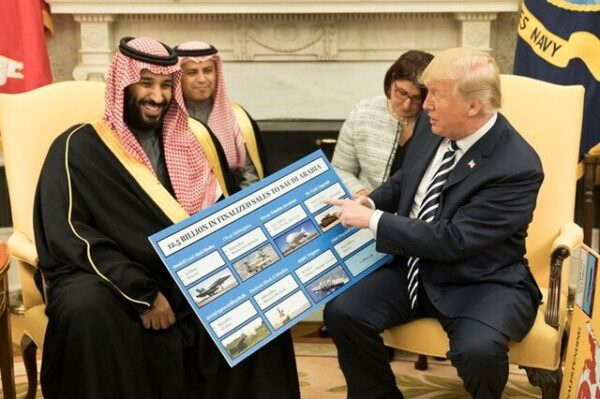

As Iran continues to slaughter protesters, key U.S. partners in the Persian Gulf have publicly moved to limit their involvement in any potential military action against Iran, with Saudi Arabia and the United Arab Emirates both stating they will not allow their airspace or territory to be used for attacks on Tehran—a position that presents new constraints for U.S. planners under President Donald Trump.
The statements come amid heightened regional tension following mass protests inside Iran and a violent crackdown by the Iranian government that has been rumored to have slaughter over 30,000 protesters. In response, the United States has surged additional military assets to the region, including the aircraft carrier USS Abraham Lincoln and its strike group, capable of launching air and missile strikes.
Even if this number is exaggerated, the brutality of the violence unleashed by the Iranian regime against its own people is beyond horrifying. This cannot, must not continue. – vía @TIME https://t.co/KuJPLIppbu pic.twitter.com/qUCLe6vd9v
— Jan-Albert Hootsen (@jahootsen) January 27, 2026
On Tuesday, Saudi Crown Prince and Prime Minister Mohammed bin Salman relayed Riyadh’s position during a phone call with Iranian President Masoud Pezeshkian, reported The Wall Street Journal. According to a Saudi state media readout, the crown prince emphasized that the kingdom “will not allow its airspace or territory to be used for any military actions against Iran.”
The Saudi declaration followed a similar announcement from the UAE’s foreign ministry on Monday, reaffirming that the country would not permit its airspace, territory, or territorial waters to be used for any hostile military actions against Iran. The statement emphasized dialogue and de-escalation as the preferred means of resolving regional crises.
Taken together, the positions of two of Washington’s closest Gulf partners mark a notable diplomatic challenge for the Trump administration, which has sought to increase pressure on Tehran over its uranium enrichment program and the suppression of domestic protests. Officials in Riyadh and Abu Dhabi have expressed concern that any direct involvement could trigger Iranian retaliation against Gulf states—an anxiety shaped by past incidents, including the 2019 attacks on Saudi oil facilities attributed to Iran or its proxies.
Analysts say that while a weakened Iranian regime might align with long-term Gulf interests, the immediate risks of escalation, economic disruption, and regional instability outweigh the potential benefits of participation. One expert characterized the stance as a refusal by Gulf states to serve as the frontline for U.S. military operations.
Retired U.S. military officials have noted that denying access to Saudi and Emirati airspace and facilities would complicate and raise the cost of any potential strike on Iran, but would not make such operations impossible. The United States retains substantial independent capabilities, including carrier-based aircraft from the Abraham Lincoln, F-15E fighter squadrons based in Jordan, and long-range bombers capable of operating from Diego Garcia in the Indian Ocean or directly from the continental United States.
Such a posture would likely result in a more unilateral U.S. action, reducing the appearance of a broad regional coalition and potentially limiting diplomatic leverage over Tehran while increasing operational burdens on American forces.
Despite the current divergence, U.S.–Saudi relations remain close. Crown Prince Mohammed bin Salman visited the White House in November, where discussions reportedly included advanced arms sales such as F-35 fighter jets and expanded access to U.S. artificial intelligence technologies. A defense cooperation agreement reaffirmed Washington as Riyadh’s primary strategic partner.
A White House spokesperson said President Trump “is watching the situation in Iran very seriously and all options are on the table if the regime executes protestors.”
Over the past few weeks there has been a “massive military buildup” of American military assets in the region with many believing that a strike against Iran is imminent.
[Read More: Dr. Oz Goes To Ground Zero Of Fraud In Minnesota]






America has just never learned anything about Arabs have we ?? They will stab you in the back for a dollar. We should have learned that lesson way back when ARAMCO was created then stolen by the sand dogs.
Just kill the Ayatollah, the same way we killed those two-bit Hamas leaders.
Selling oil to Iran then