
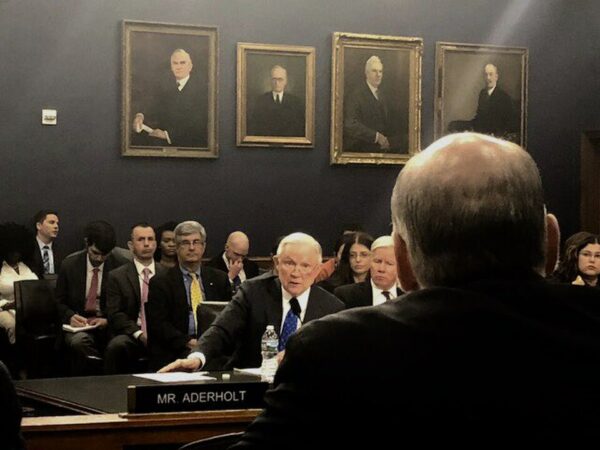

Newly declassified FBI files reveal that the bureau opened a secret investigation into Attorney General Jeff Sessions just one day after President Donald Trump fired FBI Director James Comey, raising new questions about whether senior officials moved against Trump’s attorney general in the immediate aftermath of Comey’s dismissal.
The investigation, code-named “March Toll,” began May 10, 2017, and examined Sessions’ contacts with Russian Ambassador Sergey Kislyak and whether Sessions had lied during his Senate confirmation process, according to a new report.
The inquiry lasted approximately a year before Special Counsel Robert Mueller’s office closed it without charges.
According to the declassified records, the FBI treated the Sessions case as “highly sensitive,” classifying it as a “sensitive investigative matter” and placing it under “prohibited status” under Assistant FBI Director E.W. “Bill” Priestap. Records were ordered stored in a secure facility at the FBI’s Washington Field Office.
A May 10 memo stated that “The FBI received the referenced letter dated March 20, 2017, from two U.S. senators” and said a crime or “threat to national security has or may have occurred.”
Those senators were Democrats Patrick Leahy of Vermont and Al Franken of Minnesota, who had asked Comey to investigate Sessions before Trump fired him.
Their request centered on Sessions’ answers about contacts with Russian officials during the 2016 campaign.
Leahy had asked Sessions in writing: “Have you been in contact with anyone connected to any part of the Russian government about the 2016 election either before or after election day?”
Sessions answered, “No.”
During his Jan. 10, 2017, confirmation hearing, Sessions also said he “did not have communications with the Russians.”
Leahy and Franken later called his answers “discernibly false” and “unequivocally false” after reports revealed that Sessions, then an Alabama senator, had met with Kislyak.
Sessions maintained that his testimony was truthful, arguing that his encounters with Kislyak occurred in his capacity as a senator rather than as a Trump campaign representative.
The investigation continued under Mueller after Deputy Attorney General Rod Rosenstein appointed him special counsel later in May 2017.
By May 2018, however, prosecutors had found insufficient grounds to continue.
“After interviewing the Attorney General and conducting additional investigation, the SCO closed its investigation of potential false statements or perjury in the Attorney General’s confirmation hearing testimony and related written submissions to Congress,” Mueller deputy Aaron Zebley wrote on May 8, 2018.
Zebley added: “As is the case in any investigation, material new information could lead to further investigation of those matters. The SCO advised Chuck Cooper, private counsel to the Attorney General, of that information on March 21, 2018.”
The newly released timeline places the opening of the investigation at an extraordinary moment inside the FBI. Trump fired Comey on May 9, 2017. The bureau formally opened its Sessions case the following day.
Priestap, who oversaw the sensitive investigation, also played a major role in Crossfire Hurricane, the FBI’s investigation of the Trump campaign, and in the case against former Trump national security adviser Michael Flynn.
The Sessions disclosure comes as Comey himself faces federal charges stemming from a May 2025 Instagram post showing seashells arranged as “8647,” which prosecutors allege constituted a threat against Trump. Comey has denied intending violence and is seeking dismissal of the charges.
Sessions ultimately resigned as attorney general in November 2018 after years of criticism from Trump over his recusal from the Russia investigation.
The March Toll investigation produced no charges. But the declassified documents now show that, within 24 hours of Trump removing Comey from the FBI, the bureau had quietly looked for a way to strike back against the president and his administration.
[READ MORE: Trump Acknowledges Error]



Sessions testified he never spoke with Kislyak or any Russian ABOUT THE 2016 ELECTION. Not that he never talked to a Russian. Quit spinning the truth.