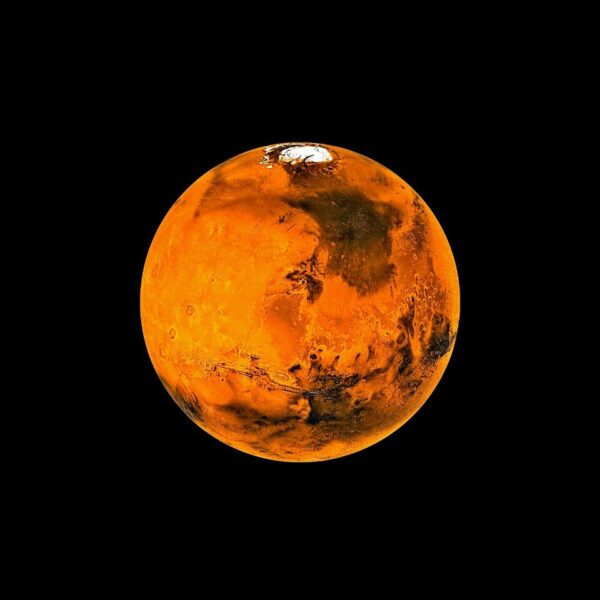

President Donald Trump said Friday that NASA is building a nuclear-powered interplanetary spacecraft scheduled to launch toward Mars in 2028, describing the mission as the beginning of a much larger American presence in deep space.
Speaking at NASA’s Johnson Space Center in Houston, Trump portrayed the spacecraft as more than a one-time technology demonstration. “This ship will be among the first of what will ultimately be a massive American Star fleet, making space travel almost as common as ocean travel today.”
The remarks came during a visit in which Trump also signed an executive order creating a presidential commission to develop plans for a U.S. Space Academy. The ceremony also honored the Artemis II crew with the Congressional Space Medal of Honor.
NASA’s spacecraft is officially known as Space Reactor-1 Freedom, or SR-1 Freedom. The agency describes it as the first fission-powered interplanetary spacecraft, designed to demonstrate nuclear electric propulsion in deep space after leaving Earth’s vicinity. NASA is targeting a late-2028 launch, with the spacecraft expected to encounter Mars in 2029. The Department of Energy is participating in the project.
The spacecraft’s reactor is expected to generate more than 20 kilowatts of electricity using high-assay low-enriched uranium. That power would feed electric thrusters, which accelerate spacecraft more slowly than conventional chemical rockets but can operate far more efficiently over long distances. NASA has said the mission will also test hardware, suppliers and procedures that could eventually be used for nuclear power systems on the lunar surface.
SR-1 Freedom is also expected to carry SkyFall, a package of three Mars helicopters derived from Ingenuity, the small aircraft that flew dozens of missions on Mars beginning in 2021. NASA says the helicopters would be released near Mars to conduct scientific observations, survey possible exploration sites and search for evidence of subsurface water or ice. Planned instruments include cameras, ground-penetrating radar and sensors measuring wind and temperature.
The mission predates Trump’s Friday announcement. NASA publicly detailed SR-1 Freedom earlier in 2026 as part of a broader effort to move space-based nuclear power from decades of research into operational missions. Officials have described the 2028 Mars launch window as an important deadline dictated by orbital mechanics.
Trump also connected the mission to a broader need for engineers, operators and military personnel as the Space Force, commercial space industry and NASA’s ambitions expand beyond the Moon. “It’s called the U.S. Space Academy. That’s a big deal,” he said, comparing the proposal to the nation’s existing military service academies.
Trump’s executive order does not immediately create a new campus. Instead, it establishes the Presidential Commission on the United States Space Academy, chaired by NASA Administrator Jared Isaacman, which will recommend a governance structure, curriculum, service requirements, possible locations and the legislative steps required to establish the academy. NASA has described the proposal as a federal institution led by the space agency that would combine technical education with leadership training and public-service obligations.
Trump used the Houston appearance to argue that American leadership in space is inseparable from the country’s broader global position. “A nation cannot be first on Earth if we’re going to be second in space,” he said.
NASA has described SR-1 Freedom as a pathfinder for a larger generation of nuclear-powered space systems. Demonstrating a working reactor in flight could reduce the risks of later lunar surface systems while helping establish an industrial base for nuclear power during the long lunar night and for increasingly ambitious missions farther from the Sun. Whether NASA can meet the 2028 launch window will depend on completing reactor integration, securing approvals for launching nuclear hardware and assembling the spacecraft on a compressed schedule.
[READ MORE: Rightwing Commentator Deported]