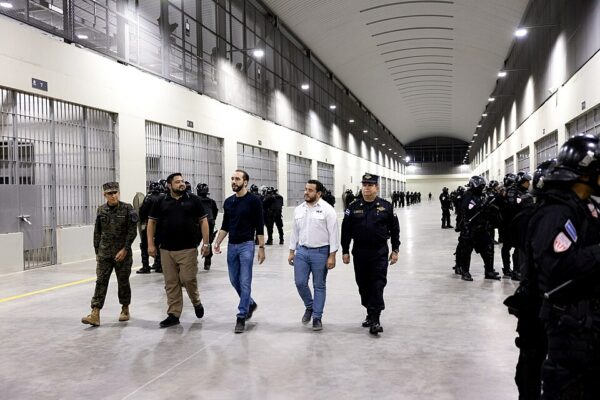

British television presenter Richard Madeley was visibly shaken after being shown graphic footage of machete attacks and other atrocities committed by MS-13 gang members during a tour of El Salvador’s Terrorism Confinement Center, the massive prison complex that has become the most recognizable symbol of President Nayib Bukele’s war on organized crime.
The footage appears in the Channel 5 documentary Richard Madeley: Inside the World’s Mega Prison, which examines the prison commonly known as CECOT and the broader crackdown that has transformed El Salvador from one of the most violent countries in the world into one of the safest in the Western Hemisphere.
I LOVE that they forced him to watch the video.
Far too many bleeding heart liberals clueless to the violence these guys are capable of. pic.twitter.com/FJbF1k1O3g
— RŌNIN (@ronin21btc) May 29, 2026
In a clip that circulated widely on social media, Madeley watches videos depicting the brutality that Salvadorans endured for years as gangs imposed a parallel system of territorial control, extortion, and murder across much of the country. One case involved a prisoner who used a machete in a territorial killing and then posted evidence of the crime online without attempting to conceal his identity.
The footage appears to leave the veteran broadcaster struggling with the moral complexity of what he has seen. “It’s solved,” Madeley remarks at one point, referring to the collapse of gang violence under Bukele’s policies. But he later describes the system as a “moral conundrum,” reflecting the broader debate surrounding the government’s aggressive methods.
CECOT opened in 2023 with capacity for as many as 40,000 inmates, explained The Guardian. Its rows of tattooed prisoners, tightly controlled cell blocks, and stark concrete interiors have made it a defining image of Bukele’s zero-tolerance approach to criminal violence.
The prison was constructed after the government imposed a state of emergency in 2022, when a sudden surge of killings prompted authorities to launch a sweeping campaign against MS-13 and Barrio 18. Since then, more than 91,000 suspected gang members and associates have reportedly been arrested. Many have faced mass trials as the government attempts to dismantle criminal organizations that had terrorized Salvadoran communities for decades.
The results have been difficult to dismiss. El Salvador’s homicide rate fell from 103 murders per 100,000 residents in 2015 to approximately 1.3 per 100,000 in 2025. That decline represents one of the most dramatic public-safety turnarounds in the modern Western Hemisphere.
For many Salvadorans, the change is measured not merely in statistics but in the return of ordinary life. Neighborhoods once controlled by gangs have reopened. Families can travel between communities without fear of crossing invisible territorial boundaries. Small-business owners no longer face the same pervasive threat of extortion. Residents who lived under the constant threat of violence have strongly supported Bukele’s refusal to treat the gangs as conventional criminal defendants operating within an otherwise stable society.
The scale of the crackdown remains extraordinary. In one recent case, wrote France 24, 486 alleged MS-13 members were placed on trial in connection with tens of thousands of crimes. The proceedings underscored the government’s argument that El Salvador was confronting not a collection of isolated offenders but a deeply entrenched criminal network that had established control over large portions of the country.
Madeley’s documentary captures the tension at the center of Bukele’s experiment. The prison’s severe discipline is difficult to separate from the crimes that produced it. The conditions inside CECOT invite legitimate questions about the limits of state power. But the graphic footage shown to Madeley also illustrates why many Salvadorans reject criticism that treats the government’s campaign as an abstract debate over criminal-justice procedure.
El Salvador’s transformation has forced a difficult question onto the international stage: How should a democratic society respond when criminal organizations become powerful enough to terrorize entire communities and impose their own rules through extortion, torture, and murder?
For Bukele’s supporters, the answer is already visible in the country’s collapsing homicide rate and the restoration of public order. Whatever concerns remain about the methods, they argue, previous approaches failed while ordinary Salvadorans paid the price. Bukele’s crackdown succeeded because it treated gang rule not as a manageable social problem but as an intolerable assault on civil society itself.
[Read More: Gun Ban Is Boom For Dealers]