
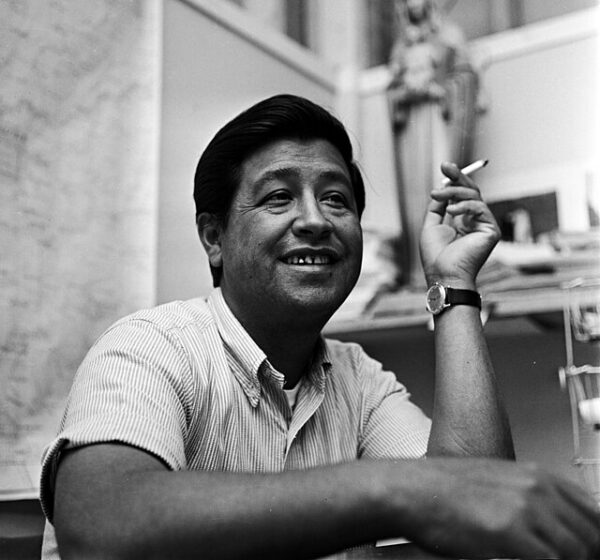

For decades, Cesar Chavez stood as a moral symbol of the American leftwing activist—a man who preached sacrifice, discipline, and dignity for the farmworkers he helped organize. That image is now under strain. Democrats have always held him up on a pedistal, using him as a way to attack foes and win praise.
https://twitter.com/GavinNewsom/status/758846593869025280
That’s about to change.
A major New York Times investigation presents a far more complicated—and deeply troubling—portrait of the late United Farm Workers co-founder, detailing allegations of sexual misconduct that, if true, cut sharply against the public mythology that has long surrounded him.
The report draws on interviews with more than 60 individuals, along with documents and corroborating evidence, to outline what it describes as a pattern of abuse within the inner circles of the movement during the 1960s and 1970s. At the center of the allegations are accounts from multiple women who say Chavez used his authority to exploit vulnerable young followers.
Two women, now in their 60s, recount being groomed and sexually abused as minors. Ana Murguia alleges that the abuse began when she was 13 years old, at a time when Chavez—then in his mid-40s—was at the height of his influence. She described a relationship that continued for years, including encounters in his office. Debra Rojas similarly alleges that inappropriate contact began when she was 12 and escalated to rape by age 15 during a prolonged union march in California—conduct that would have constituted statutory rape under state law at the time.
The investigation also includes a striking disclosure from Dolores Huerta, Chavez’s longtime collaborator and co-founder of the union, who is now 95. Speaking publicly for the first time about her experiences, Huerta alleged that Chavez assaulted her twice in the 1960s while she was a young mother deeply embedded in the movement. She described the first incident as one shaped by manipulation and power imbalance, and the second as forced and non-consensual in a setting where she felt she could not escape. According to Huerta, the encounters resulted in pregnancies she kept secret, arranging for the children to be raised by other families.
The Times further reports that Chavez fathered at least four children with three different women outside his marriage, citing evidence that includes DNA matches from commercial ancestry services. Huerta is said to be the mother of two of those children.
The reaction has been swift and, in some cases, immediate. Several events planned around March 31—Chavez’s birthday, recognized as a federal commemorative holiday since 2014—have been canceled. Officials in parts of California and the broader Southwest are now weighing whether to remove Chavez’s name from public institutions, including schools, streets, and government buildings. The United Farm Workers union has condemned the alleged conduct and expressed support for survivors, while emphasizing that the broader cause Chavez helped lead cannot be reduced to the actions of one man.
That distinction—between legacy and conduct—is now at the center of a broader reassessment. Chavez, who died in 1993, has long been celebrated for his commitment to nonviolent organizing, his use of boycotts, and his hunger strikes, all of which helped bring national attention to the plight of agricultural workers. His name adorns highways, schools, and public spaces across the country, a testament to the enduring power of that legacy.
But the allegations now emerging place him in a growing category of liberal activist figures whose private behavior, revealed long after their deaths, makes you wonder who else they’ve been protecting.
[Read More: American Golden Boy Denied By Hall of Fame]







Same for other activists ???