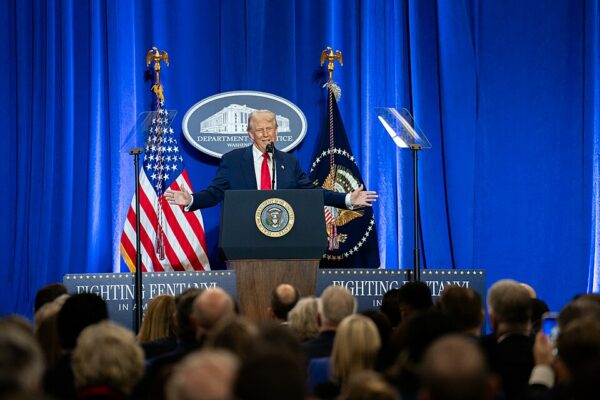
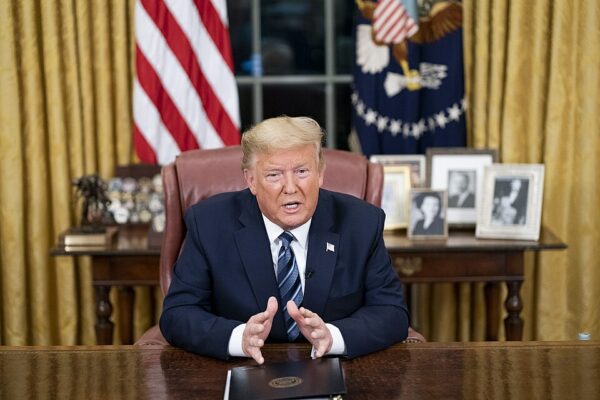

President Donald Trump’s effort to limit American involvement in Yemen faces a growing test as Iranian-backed Houthi fighters expand their territory and attack Saudi Arabia, threatening shipping routes already strained by the wider conflict with Iran. Trump has declined Saudi requests for direct U.S. military action against the Houthis, offering intelligence and targeting assistance as the fighting intensifies, according to Reuters.
Saudi Crown Prince Mohammed bin Salman sought additional American support as Houthi advances strengthened the militia’s control over Yemen’s Red Sea coast. The confrontation leaves Washington weighing requests from a regional partner against the prospect of a broader military commitment while negotiations with Tehran remain stalled.
Houthi fighters were engaged in heavy combat Sunday with Saudi-backed Yemeni government troops, pressing an offensive to seize strategic ground. A day earlier, the militia said it had launched missiles and drones at Riyadh and Saudi oil facilities in retaliation for what it described as hundreds of Saudi airstrikes and other attacks inside Yemen.
The fighting threatens access to the Bab al-Mandab Strait, a critical passage for commercial vessels and Saudi oil shipments that has become more important since Iran effectively closed the Strait of Hormuz, explained The New York Times. Houthi gains along the Red Sea coast have increased the group’s ability to threaten that traffic, adding another maritime security problem to Trump’s confrontation with Tehran.
Saudi officials have said they are reluctant to wage another campaign against the Houthis without stronger American backing. Their earlier intervention became a costly stalemate, damaged the kingdom’s reputation and contributed to a humanitarian catastrophe in which hundreds of thousands of Yemenis died from fighting, hunger and disease.
Riyadh has not confirmed recent airstrikes in Yemen or responded to a Houthi claim that the militia shot down a Saudi warplane last week. Addressing the attack on Riyadh, Saudi-led coalition spokesman Maj. Gen. Turki al-Maliki said the kingdom “holds the inherent right to take appropriate measures,” without specifying what action it might take.
On the ground, fighting Sunday centered on the southwestern districts of al-Wazi’iyah, al-Madaribah and al-Arah, according to Abdul Basit al-Baher, an officer with the Saudi-backed Yemeni army. Capturing those mountainous areas would allow the Houthis to cut Taiz off from the southern port of Aden and encircle government forces defending the city, he said.
Clashes have also erupted around Kahboub, high ground overlooking the Bab al-Mandab Strait, according to two Yemeni officials who spoke anonymously because they were not authorized to brief reporters. The territorial offensive has accompanied an effort by the Houthis to portray themselves as Yemen’s national authority.
“The Houthis are trying to consolidate gains on the West Coast and to take additional territory, particularly in Taiz and Marib governorates,” said April Alley, a Yemen specialist and senior fellow at The Washington Institute. “What I am seeing now is the Houthis using a dual-track approach to expansion: military and narrative. From the narrative perspective they are saying: We are all Yemeni, let’s push the Saudis out and then find solutions.”
The escalation comes as Washington and Tehran remain at odds over conditions for renewed negotiations. Mohsen Rezaei, secretary of Iran’s Supreme National Security Council, wrote Saturday: “Seven conditions for the start of any negotiations have been communicated to the U.S. government. Tehran’s message is clear and unambiguous: If Washington wants to get out of the predicament it has created for itself and avoid becoming further trapped in it, it has no choice but to accept Iran’s rights and conditions.”
Yemen’s war began in 2014, when the Houthis captured Sanaa, prompting a subsequent Saudi-led intervention aimed at restoring the internationally recognized government. A fragile cease-fire reached in 2022 collapsed amid the broader U.S.-Israeli conflict with Iran, and hostilities resumed in July after a strike on Sanaa’s airport.
The Houthis blamed Saudi Arabia for the airport attack, while the Saudi-backed Yemeni government said it carried out the raid to prevent an Iranian aircraft from landing. The militia subsequently announced a blockade of Saudi shipping in the Red Sea, widening a confrontation Trump has so far declined to join directly.
Houthi officials have signaled that their territorial ambitions extend beyond their northern stronghold. Last week, Mohammed al-Bukhaiti said the group “assures everyone that it is concerned with liberating every inch of Yemeni territory.” He described officials of the internationally recognized government as “Saudi mercenaries.”
[READ MORE: Another Scam Uncovered By DOJ]