

The U.S. military is preparing for the possibility of a sustained campaign against Iran that could last several weeks if President Donald Trump authorizes strikes, according to two U.S. officials familiar with the sensitive planning.
The contingency planning marks a potential escalation well beyond prior direct confrontations between Washington and Tehran. It comes amid renewed tensions over Iran’s nuclear program and ballistic missile development, even as diplomatic channels remain open, writes The Jerusalem Post.
Last week, American and Iranian representatives held indirect talks in Oman aimed at reviving negotiations to curb Tehran’s nuclear activities. The discussions followed a significant U.S. military buildup in the region ordered by Trump, a move that has intensified speculation about the prospect of armed conflict.
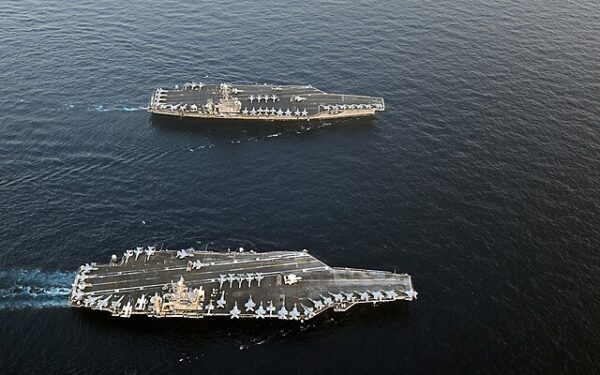
The Pentagon has deployed an additional aircraft carrier strike group to the Middle East, along with thousands of troops, advanced fighter jets, guided-missile destroyers, and other assets configured for both offensive and defensive operations. Defense officials have described the posture as flexible, but the scale of the buildup suggests preparation for more than a limited strike.
Speaking Friday to service members at a military base in North Carolina, Trump acknowledged the difficulty of securing an agreement with Iran.
“Sometimes you have to have fear. That’s the only thing that really will get the situation taken care of,” Trump said.
A White House spokesperson, Anna Kelly, confirmed that contingency options are under review but declined to detail operational plans.
“President Trump has all options on the table with regard to Iran,” Kelly said. “He listens to a variety of perspectives on any given issue, but makes the final decision based on what is best for our country and national security.”
Officials familiar with the discussions say the current planning differs substantially from last year’s limited “Midnight Hammer” operation, in which U.S. stealth bombers struck Iranian nuclear facilities in a single, concentrated mission. A broader campaign now under consideration could extend beyond nuclear infrastructure to include elements of Iran’s government and security apparatus.
Military analysts caution that any prolonged engagement would carry significant risks. Iran possesses an extensive arsenal of ballistic and cruise missiles capable of targeting U.S. forces and regional allies. Retaliation is widely viewed as likely in the event of American strikes, raising the prospect of repeated exchanges that could draw neighboring states into a wider conflict.
The United States maintains military installations across the Middle East, including in Jordan, Kuwait, Saudi Arabia, Qatar, Bahrain, the United Arab Emirates, and Turkey. Iran’s Revolutionary Guards have previously warned that attacks on Iranian territory would be met with strikes against U.S. bases in the region.
Trump has repeatedly warned that Iran’s nuclear ambitions and missile development will not be permitted to advance unchecked. In recent remarks, he described the alternative to a negotiated settlement as “very traumatic,” underscoring the stakes of the standoff.
Israeli Prime Minister Benjamin Netanyahu, during a recent meeting with Trump in Washington, stressed that any agreement must address Israel’s core security concerns. Israel has long viewed Iran’s nuclear and missile programs as existential threats.
Tehran, for its part, has signaled a willingness to negotiate limits on its nuclear activities in exchange for sanctions relief. Iranian officials, however, have rejected efforts to link those talks to restrictions on their missile program, a longstanding point of contention in prior negotiations.
For now, diplomacy and deterrence proceed in parallel. But the scope of U.S. military preparations suggests that Washington is readying for an endgame mission, not just another strike.
[Read More: Liberal Woman Tries To Light ICE Facility On Fire]